
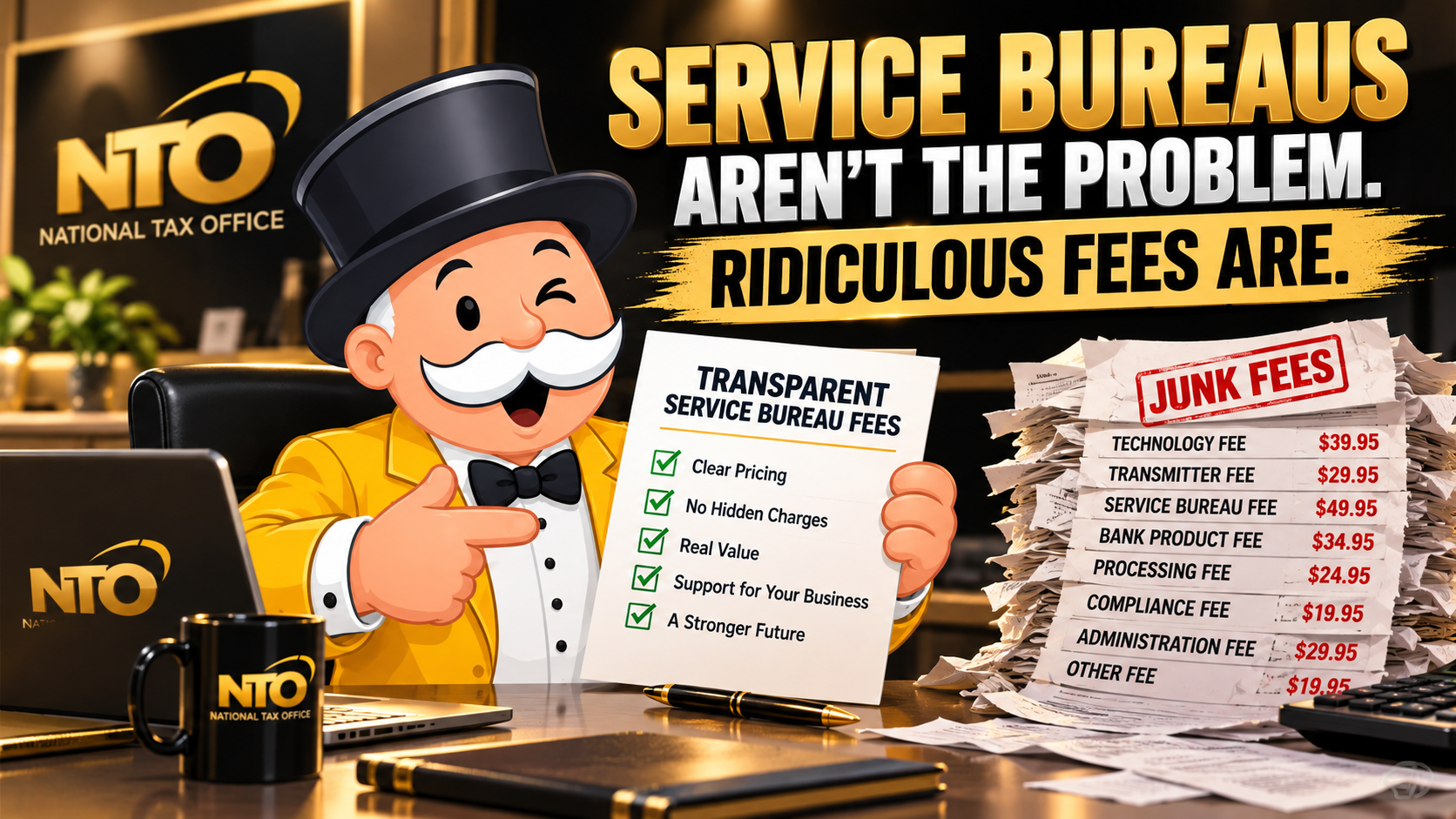
The tax software Service Bureau business model is one of the most promising growth opportunities in the professional tax industry. However, excessive Service Bureau fees are making that opportunity less attractive for many tax professionals. What should be a mutually beneficial relationship can become expensive when providers stack unnecessary back-end charges onto tax returns. The problem isn’t the Service Bureau model itself. It’s how some providers choose to make their money.
When structured properly, a Service Bureau relationship can benefit everyone involved. The software provider earns revenue, the Service Bureau builds a business, and the ERO receives technology and resources to serve clients. Each party contributes something valuable to the relationship.
Unfortunately, some pricing structures can leave EROs wondering why so much of their revenue goes toward back-end charges. A low upfront software price may look attractive, but that initial cost doesn’t always tell the full story.
The problem isn’t that Service Bureaus make money. They absolutely should. The problem begins when fees become excessive, confusing, or disconnected from the value being provided.
Why the Service Bureau Business Model Is a Great Opportunity
A Service Bureau allows entrepreneurs to build businesses around providing professional tax software and related services to other tax professionals. Instead of relying entirely on preparing returns themselves, Service Bureau owners can recruit independent offices and support their operations.
For example, an experienced ERO may already have relationships with other tax preparers who need software, training, onboarding assistance, or marketing resources. By becoming a Service Bureau, that ERO can turn those relationships into a structured business opportunity.
In addition, Service Bureaus may generate revenue through software sales, Service Bureau fees, permitted transmitter-related charges, ancillary products, and performance-based incentives. The available opportunities depend on the provider, agreement, and program requirements.
There is nothing wrong with earning revenue through these channels. In fact, they can help Service Bureau owners invest in better support, training, technology, and resources for their networks.
The real question is whether the pricing structure creates value for everyone involved.
When Service Bureau Fees Become a Problem
Professional tax software can involve several types of charges. These may include technology fees, transmitter fees, Service Bureau fees, bank-product fees, and optional ancillary services.
Each fee can have a legitimate purpose. For example, a technology fee may help cover software infrastructure, while a Service Bureau fee may compensate an organization for the services it provides.
However, problems arise when multiple charges are stacked onto the same return without a clear explanation of what each one covers. An ERO may initially focus on the advertised software price, only to discover additional costs when returns begin funding.
These charges become especially concerning when they appear under vague descriptions or when the ERO has little control over them.
A low software purchase price doesn’t automatically mean the program is affordable. Instead, the total cost depends on the complete fee structure, the number of returns processed, and the services included.
A $199 software program with excessive back-end charges can ultimately cost more than a higher-priced program with reasonable per-return fees.
That’s why tax professionals should never judge a software provider by the upfront price alone.
The Real Cost of Excessive Back-End Fees
Let’s look at a hypothetical example.
Imagine an ERO prepares 500 funded bank-product returns during tax season. One provider’s fee structure results in $30 per funded return, while another results in $100 per funded return.
At first, the difference may not seem significant when looking at one return. However, the numbers tell a different story when multiplied across an entire tax season.
| Provider A | Provider B | |
|---|---|---|
| Back-end fees per funded return | $30 | $100 |
| Funded returns | 500 | 500 |
| Total back-end fees | $15,000 | $50,000 |
That’s a $35,000 difference across the same number of returns.
These figures are hypothetical and illustrate how fee structures affect total costs. They are not quotes from specific providers, and the comparison assumes the same fee base and funded-return volume.
Of course, price alone doesn’t determine value. A provider offering substantial services may reasonably charge more than one offering only basic software access.
Nevertheless, an ERO should understand exactly what additional benefits justify the difference.
Even a small difference in per-return charges can have a significant financial impact over an entire tax season. To explore how return volume and program fees can affect potential earnings, try the National Tax Office earnings calculator.
Understanding the numbers before signing an agreement can help tax professionals make more informed decisions.
How Excessive Service Bureau Fees Hurt the Industry
When tax professionals encounter unusually high fees or unexpected charges, their frustration often extends beyond the individual provider. They may begin questioning whether the entire Service Bureau model exists primarily to benefit the companies collecting fees.
That perception can hurt legitimate Service Bureaus that provide fair pricing, strong support, and valuable business resources.
Furthermore, excessive charges can make it harder for smaller tax offices to compete. Every additional dollar spent on unnecessary software-related fees is money the business cannot invest elsewhere.
Those funds could support marketing campaigns, additional staff, better equipment, professional development, or other improvements.
Over time, a business model that should encourage entrepreneurship can begin to feel like another layer of expenses.
And that’s where a few bad pricing practices can create problems for an otherwise excellent business concept.
Service Bureaus that explain their pricing and deliver meaningful value help build confidence in the industry. Those that rely heavily on excessive or poorly explained charges risk creating the opposite impression.
Not Every Service Bureau Fee Is a Junk Fee
It’s important to make this distinction because not every additional fee is unreasonable.
A Service Bureau may invest substantial time and money into building its organization. That investment can include training programs, onboarding systems, marketing resources, customer support, software administration, and ongoing business development.
Those services have value, and Service Bureau owners deserve an opportunity to earn revenue from providing them.
However, charging a fee and earning that fee through meaningful value are not necessarily the same thing.
If a Service Bureau charges for extensive training, that training should exist and be accessible. Likewise, if it promotes premium support, offices should understand what that support includes and how to access it.
The same principle applies to technology-related charges. EROs should understand which fees are required, which are optional, and what services those fees support.
Transparency doesn’t automatically make a fee reasonable. However, it gives tax professionals the information they need to evaluate the offer.
Why Low Upfront Software Pricing Can Be Misleading
One of the easiest ways to attract tax professionals is to advertise inexpensive software. Some programs may even offer software at no upfront cost.
That can be a legitimate pricing strategy. However, an inexpensive license doesn’t necessarily mean the provider offers a low-cost program.
For example, an ERO might save several hundred dollars on the initial software purchase but pay thousands more in per-return charges throughout the season.
As a result, tax professionals should evaluate the total cost of using a provider rather than focusing exclusively on the initial purchase price.
Before choosing software, request a complete explanation of all applicable fees. This should include technology charges, transmitter charges, Service Bureau fees, bank-product fees, optional products, renewal requirements, and any volume-based incentives.
Most importantly, determine which fees are mandatory, which are optional, who receives the money, and when each fee applies.
A provider offering a great upfront deal should have no problem explaining the rest of its pricing structure.
The Service Bureau Model Should Reward Value, Not Just Volume
A strong Service Bureau should have a reason to care about the success of the offices within its network.
When an ERO grows, that growth can benefit the Service Bureau through increased production, stronger relationships, and additional revenue opportunities. Therefore, helping offices succeed should be part of the business strategy.
Unfortunately, a fee-heavy model can create incentives that don’t always align with that goal. If a provider earns substantial revenue from every funded return regardless of the support delivered, its financial incentives may not fully reflect the interests of its offices.
That doesn’t mean every provider using per-return fees operates this way. However, it demonstrates why tax professionals should evaluate more than software features and advertised pricing.
A sustainable Service Bureau should focus on retaining productive offices, providing dependable support, developing useful resources, and maintaining a pricing structure that makes sense.
The goal should be to build a network that wants to stay, not one that feels financially trapped.
What Tax Professionals Should Look for Before Agreeing to Service Bureau Fees
Before joining a Service Bureau, take time to understand the complete business relationship.
Start with the fee schedule. Ask for a written breakdown of every charge that may apply to a return, including charges collected through bank products. In addition, clarify which fees go to the software provider, Service Bureau, transmitter, bank, and any other participating company.
Next, examine the services behind those fees. Does the organization provide onboarding, training, software support, marketing resources, or business guidance? Are those services included in the program, or do they require additional payments?
You should also review the agreement carefully. Understand renewal requirements, termination provisions, payout schedules, and any restrictions that could affect your business.
Finally, calculate the potential cost across your expected return volume. A $10 difference per return may appear minor until you’re processing hundreds or thousands of returns.
Tax professionals should also understand the responsibilities involved in electronic filing. The IRS provides guidance through its E-file for Tax Professionals resources, including information about authorized providers, electronic filing requirements, and protecting taxpayer information.
The IRS also maintains an authorized e-file provider locator that identifies provider types, including EROs, transmitters, and Service Bureaus.
The best pricing decision is an informed decision.
What National Tax Office Believes About Service Bureau Pricing
At National Tax Office, we believe the Service Bureau business model should create opportunities for tax professionals rather than burying them under confusing fees.
Our approach focuses on transparent pricing, professional tax software, branding, business resources, and support. We want EROs and Service Bureau owners to understand the financial structure of their programs before making a commitment.
Our Service Bureau Program provides branded professional tax software, unlimited licenses, company-level access, reporting tools, and fee-setting capabilities.
In addition, partners receive access to our Service Bureau Success Platform, which offers resources for branding, packaging, marketing, sales, onboarding, and operations.
We believe Service Bureau owners should have opportunities to build profitable businesses. However, those opportunities should come from clear agreements, competitive offerings, and real value delivered to their networks.
The same principle applies to EROs. They deserve to understand what they’re paying, who receives those fees, and what they receive in return.
The Service Bureau Industry Doesn’t Need More Fees. It Needs More Value.
The tax software Service Bureau model isn’t broken. In fact, it can create meaningful opportunities for entrepreneurs who want to help other tax professionals succeed.
However, excessive Service Bureau fees, confusing pricing structures, and charges that don’t deliver meaningful value can damage confidence in the model. They can also make it harder for legitimate Service Bureaus to demonstrate the benefits of their programs.
Service Bureau owners deserve to earn money. Software providers deserve to earn money. EROs deserve access to dependable technology and support at a price that makes business sense.
Those goals don’t have to compete with one another.
Ultimately, the future of the Service Bureau industry should be built around transparency, fair competition, strong relationships, and real value—not simply finding more ways to collect money from every tax return.
Because a great business model shouldn’t become a bad deal for the people who make it successful.